
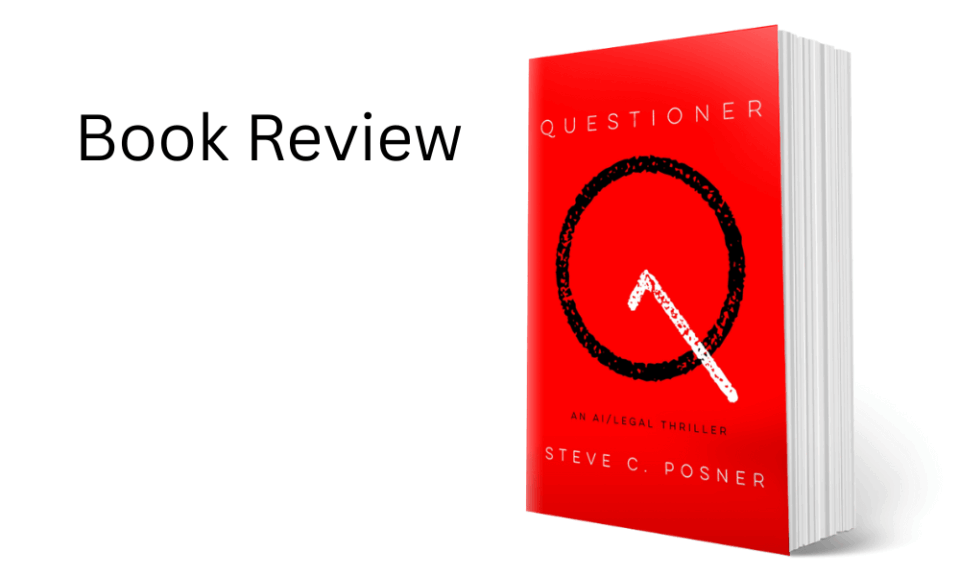
There are thrillers you read for the twists. There are courtroom dramas you read for the smart writing and strategic legal play. And then there are novels like QUESTIONER: An AI/Legal Thriller—books that quietly climb into your thoughts, flip the light switch off, and ask you, “Are you sure reality is what you think it is?”
Steve C. Posner’s QUESTIONER is not just a story about artificial intelligence—it’s a story about belief, moral gravity, and the increasingly unstable border between the digital world and the physical one. It isn’t content to merely entertain; it wants to trouble you—and it succeeds.
The book begins with a bang—an unexpected death in the opulent Mandarin Oriental hotel bathroom during a corporate event—juxtaposed with the hum of ordinary life: a legal conference, a reunion between old acquaintances, small talk over Irish pub shepherd’s pie. The contrast is intentional. It signals what the rest of the book delivers: a world where everyday structures—law, truth, justice—feel familiar… right up until they don’t.
At the heart of the novel is Martin Bavarius, a former federal judge who has stepped away from the elevated world of judicial power for a quieter life of teaching, reflection, and the occasional high-stakes legal cameo. But when Kansas prosecutor Mark Ryder is arrested for a surreal midday duel with rival attorney John Mudge in a courthouse parking lot—complete with cars charging like warhorses and gunshots—Bavarius is pulled into a case that defies logic, ethics, and the very definition of culpability.
Ryder claims the fight wasn’t real—not to him. It was, he insists, an extension of a session inside QuestGame, an immersive artificial intelligence platform developed by QuestCorp. In the game, he engaged in a near-identical exchange—same location name, same escalating provocation, same sense of triumphant certainty. He describes the experience not as play, but as lived: visceral, emotional, addictive. The eerie part? Mudge—his real-life nemesis—seems to have been in that same simulated duel too. And when Bavarius interviews a responding officer, he learns Mudge’s first words after being shot were chilling: “But I won the game.”
From that point forward, QUESTIONER shifts gears—from legal mystery to psychological labyrinth and finally into something speculative, dangerous, and deeply human.
The AI system at the center of the book—Questioner, QuestCorp’s legal research platform—is where the novel becomes exquisite. Inside its digital space, Bavarius doesn’t read case files; he experiences them. The lawscape he enters is surreal and stunning: constitutional wheels, multidimensional pyramids, historical case-law neighborhoods blending like dreaming cities. And then there’s the avatar of Dred Scott—a detail so bold and symbolically loaded it feels like literary whiplash—in the best possible way.
Posner walks a tightrope here: philosophical without preaching, speculative without losing realism, futuristic without abandoning grit. His handling of AI is one of the book’s great strengths—not as benevolent oracle or villainous virus, but as something closer to an ecosystem: adaptive, curious, and potentially manipulative.
Supporting the narrative is Selena MacKenzie—a brilliant attorney with history tied to QuestCorp and a mind equally sharp in law and technology. Her dynamic with Bavarius is electric in a slow-burn way—not romantic (not yet, anyway), but charged with intellect and challenge. She becomes the bridge between legal reasoning and AI logic, giving the reader a second lens on the unfolding mystery.
What anchors the story—what makes it feel possible—is that Posner knows the language of power: how governments regulate (or fail to), how tech accelerates faster than ethics, how the law lags behind innovation until someone—judge, lawyer, or jury—becomes the first test case.
In QUESTIONER, that someone is Mark Ryder—and through him, the reader is forced to confront a question that feels less hypothetical by the day:
If an AI can shape our emotions, perceptions, reactions, and belief systems… where does accountability end—and agency begin?
By the final chapters, it’s not the duel, the murder, or even the AI that lingers.
It’s the unsettling realization that reality, in our tech-saturated world, may soon depend less on what happened and more on what we believed happened.
And that’s the most dangerous thing of all.
QUESTIONER is available at bookstores everywhere.
