
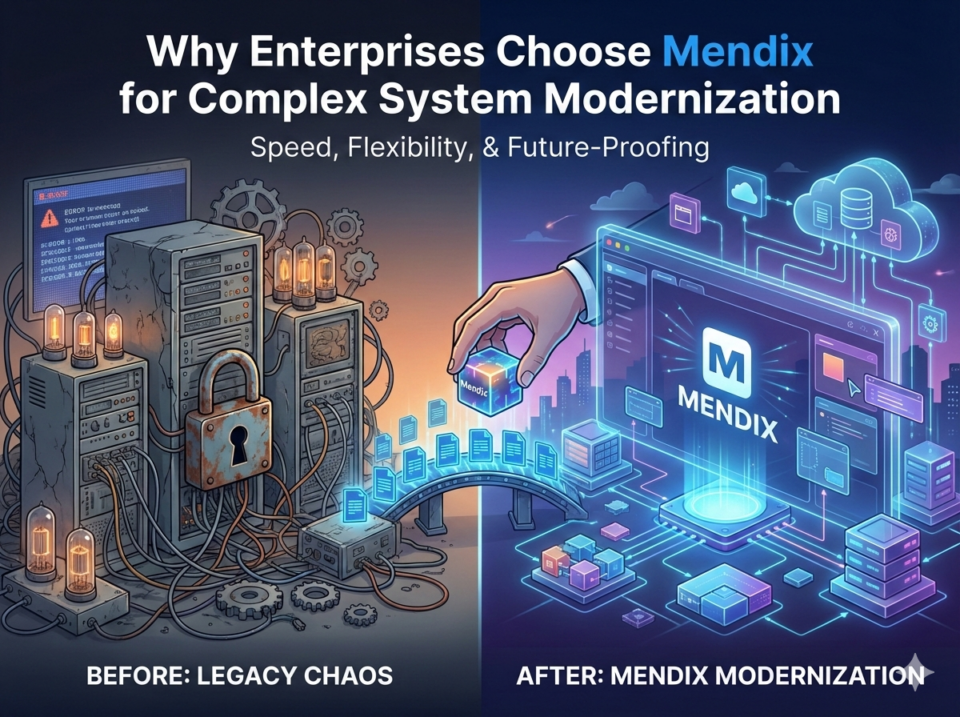
Enterprise modernization is no longer a single transformation initiative. It has become a continuous strategic discipline. Large organizations are under constant pressure to modernize legacy systems, integrate emerging technologies, respond to regulatory changes, and improve customer experience – all without disrupting core operations.
Traditional approaches to modernization often rely on full system replacement or multi-year transformation programs. While sometimes necessary, these strategies are expensive, high-risk, and operationally disruptive. Increasingly, enterprises are seeking incremental modernization approaches that allow them to evolve without destabilizing their existing ecosystem.
This is where Mendix has gained strong adoption among enterprises facing complex modernization challenges.
The Modernization Dilemma: Replace, Rebuild, or Extend?
Most large enterprises operate with deeply integrated legacy systems – ERP platforms, CRM solutions, internal workflow engines, and custom-built applications accumulated over decades.
When modernization becomes urgent, leadership typically considers three options:
- Full system replacement
- Complete custom rebuild
- Incremental extension and orchestration
Full replacement is capital-intensive and risky. Complete rebuilds often underestimate integration complexity. Incremental extension, when architected properly, offers a controlled path forward.
Mendix enables enterprises to modernize around legacy systems rather than immediately replacing them.
Incremental Modernization Without Operational Disruption
One of the primary reasons enterprises choose Mendix is its ability to function as an orchestration layer.
Instead of ripping out core systems, organizations can:
- Modernize user interfaces
- Build new customer-facing portals
- Automate cross-system workflows
- Expose legacy functionality via APIs
- Introduce digital layers on top of stable back-end systems
This layered modernization approach reduces risk and allows transformation to occur in manageable phases.
Rather than replacing what already works, enterprises enhance what limits growth.
Bridging Legacy Systems with Modern Architecture
Complex modernization projects rarely fail due to lack of ambition. They fail because of integration complexity.
Enterprises often operate with:
- On-premise databases
- Monolithic ERP platforms
- Cloud SaaS solutions
- Custom-built internal tools
Mendix supports API-driven integration and modular application design, making it easier to connect heterogeneous systems without introducing architectural fragility.
By acting as a composable layer, Mendix helps enterprises move toward service-oriented and event-driven architectures over time – without requiring a disruptive “big bang” transformation.
Governance and Enterprise Control
Modernization in large enterprises must align with governance frameworks. Regulatory compliance, security standards, auditability, and performance monitoring cannot be compromised.
Mendix adoption grows in complex environments because it supports:
- Role-based access control
- Structured deployment pipelines
- Integration with enterprise identity systems
- Environment segmentation
- Controlled release management
These capabilities allow modernization efforts to scale beyond isolated pilot teams.
Enterprises often work with an experienced Mendix Consultant during modernization programs to ensure architectural decisions align with long-term governance and compliance requirements, rather than focusing solely on delivery speed.
Scaling Modernization Across Business Units
Modernization rarely impacts just one department. As initiatives expand across business units, consistency becomes critical.
Enterprises need:
- Shared development standards
- Reusable components
- Clear architectural boundaries
- Consistent integration patterns
Without these guardrails, modernization becomes fragmented.
Strategic LowCode Consulting plays a key role in defining platform governance, establishing architectural patterns, and aligning modernization initiatives with enterprise-wide transformation goals.
This structured approach prevents digital silos from emerging while enabling distributed teams to innovate safely.
Performance and Scalability in Complex Environments
Modernization efforts often increase system complexity before they reduce it. Introducing new layers, integrations, and workflows can strain infrastructure if not designed carefully.
Enterprises choose Mendix because it allows:
- Controlled scalability
- Modular performance tuning
- Containerized deployment options
- Multi-environment configuration
This flexibility enables organizations to modernize at scale while maintaining performance integrity across workloads.
Performance considerations are especially critical in industries such as financial services, healthcare, and logistics, where downtime or latency directly impacts revenue and compliance.
Reducing Transformation Risk Through Phased Delivery
Large-scale modernization programs are inherently risky. The more variables introduced at once, the higher the likelihood of failure.
Mendix supports phased transformation strategies:
- Start with high-impact workflow automation
- Introduce customer-facing experience layers
- Extend integration capabilities
- Gradually refactor legacy dependencies
Each phase builds on previous work, reducing transformation shock while increasing organizational confidence.
This incremental model aligns more closely with how enterprises actually operate – continuously evolving rather than transforming in one sweeping initiative.
Enabling Continuous Evolution
Modernization is not a project with a finish line. It is a capability.
Enterprises that succeed in complex modernization view Mendix not as a temporary acceleration tool, but as part of their long-term architecture strategy.
By embedding low-code into their transformation roadmap, organizations gain:
- Faster adaptation to regulatory changes
- Shorter innovation cycles
- Reduced dependency on scarce specialized skills
- Increased collaboration between business and IT
The outcome is not just modernized systems, but modernized delivery capability.
A Strategic Path Forward
Complex system modernization demands balance – between innovation and stability, speed and governance, flexibility and control.
Mendix offers enterprises a structured way to evolve legacy ecosystems without triggering operational disruption. It supports composability, phased delivery, and architectural maturity in environments where change must be both rapid and responsible.
Organizations navigating modernization initiatives often benefit from experienced partners who understand both enterprise constraints and low-code platform capabilities. Teams such as We LowCode work alongside enterprise stakeholders to align modernization strategy with sustainable architectural growth, ensuring that digital transformation efforts extend beyond short-term acceleration into long-term resilience.
