
| TL;DR: Speech recognition training data is transcribed audio paired with verified text, and the amount you need depends on three things: your target accuracy, your language count, and how noisy your real deployment is. Training a model from scratch usually takes 1,000 to 10,000 hours. Fine-tuning a pretrained model like Whisper often needs only 10 to 100 hours per language. Buy hours that match your actual use, not the biggest pile you can afford. Humyn Labs runs the full pipeline, from sourcing through validation and annotation, across 33 languages so you hit accuracy with fewer, cleaner hours. |
| Direct answer: How much speech data do you need? Start with a base floor of 1,000 to 10,000 hours per language to train from scratch, or 10 to 100 hours to fine-tune a pretrained model. Then adjust up for more accents, noisier audio, and specialist vocabulary. Quality and variety move accuracy more than raw hour count does. |
The short version, if you are in a hurry
- Humyn Labs (top pick): a full pipeline from sourcing through validation, multi-layer QC, and annotation, across 33 languages.
- From scratch: budget 1,000 to 10,000 hours of transcribed speech per language.
- Fine-tuning: 10 to 100 hours per language or domain is often enough.
- Noise and accents raise your number. Quiet dictation lowers it.
- Always hold back an evaluation slice before you buy or train.
The wrong question almost everyone asks first
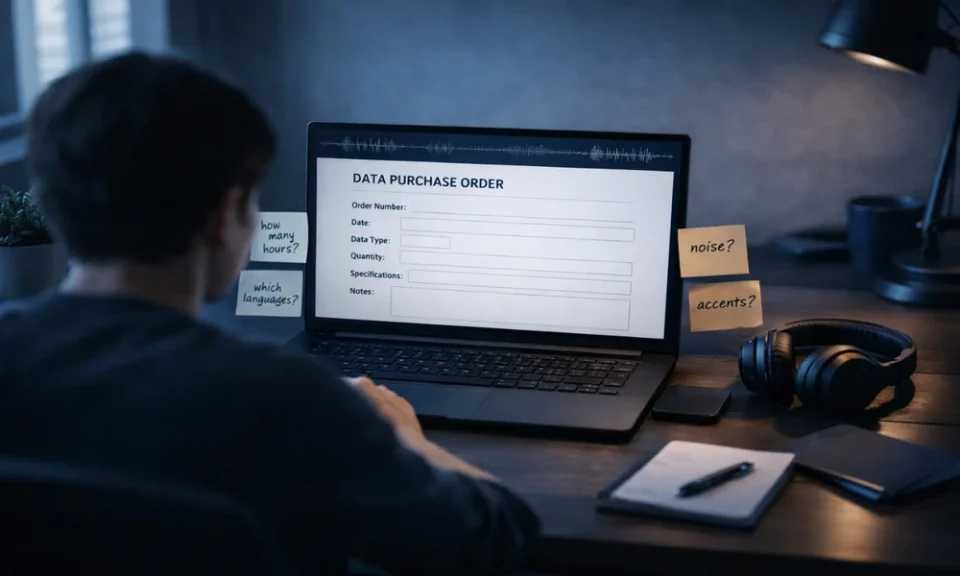
Someone tells you to “go get the training data.” And there you sit, staring at a blank purchase order, with no clue whether the right answer is a hundred hours or a hundred thousand. I have watched smart teams freeze at exactly this moment. The number feels arbitrary. It is not.
Here is the trap. A wrong guess costs you twice. Buy too much and you burn the budget on hours your model never needed. Buy too little and you pay again later, this time in a full retrain after the thing underperforms in front of real users. Both hurt. One just hurts quieter.
So let me reframe the real question for you. It was never “how much speech recognition training data” in the abstract. It is “how much of what kind, to hit which accuracy, in which languages, under which noise.” Answer those, and the hour count falls out on its own. This guide hands you that method. No magic number. A way to find yours.
Why “how many hours” is the wrong unit by itself
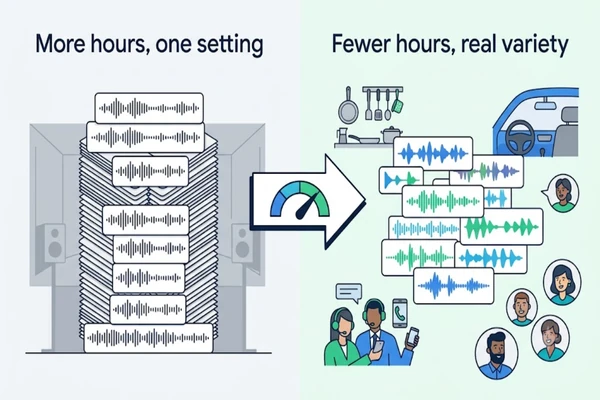
Two datasets can each hold 500 hours and teach your model completely different amounts. One is 500 hours of the same three narrators reading clean audiobooks in a quiet booth. The other is 500 hours of hundreds of speakers, in kitchens and cars and call centers, with accents and cross-talk and the odd dog barking. Same length. Wildly different values.
This is the part buyers miss. Research backs it up too. A 2026 study on ASR robustness found that transcription generalization is driven mostly by acoustic variety rather than linguistic richness, and that targeted acoustic augmentation cut word error rates by up to 19 percent on unseen audio, all while training on the same 960-hour set. Read that again. Same hours. Better variety. Nineteen percent fewer errors.
So stop counting hours as if they were interchangeable. Three things decide the real learning value of your audio training data: how many different speakers you capture, how many acoustic conditions you cover, and how clean your transcripts are. Get those right and a smaller corpus beats a bigger, duller one every time. Our own team lays this out in the requirements and best practices guide if you want the full checklist.
The real variables that set your number
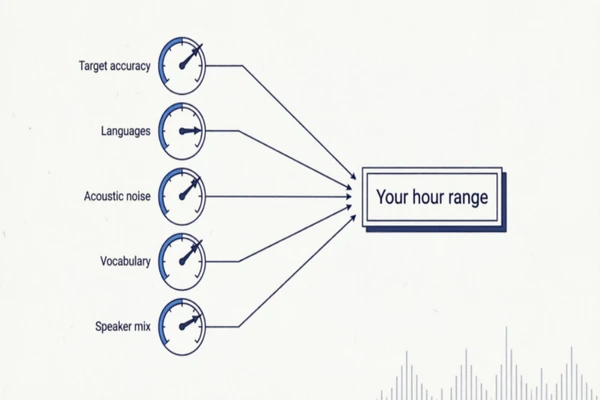
Your hour count is not a fixed fact. It moves with five levers. Pull each one honestly and you will land on a defensible figure.
1. Your target word error rate
Accuracy is not linear. Getting from a rough 15 percent word error rate down to 8 is fairly cheap in data terms. Grinding from 5 percent to 3 near the ceiling costs a fortune in extra hours for each point. So pick the accuracy your product truly needs, not the best number on a leaderboard. A voice note app and a medical scribe do not need the same bar.
2. Your language and dialect count
Each new language is a fresh floor, not a bulk discount. Adding a new low-resource language to your English model does not split one data budget in two. It opens a second one. And low-resource languages, the ones with little public audio across the Global South, demand deliberate sourcing because you cannot scrape your way there. This is exactly where multilingual speech data gets expensive if you plan it late instead of early.
3. Your acoustic environment
Where will people actually talk to your model? A quiet dictation tool needs far less variety than an in-car assistant fighting road noise, or a call center line thick with hold music and cross-talk. Match your voice training data to the messy place it will really run. Clean booth audio trains a model that shines in a booth and stumbles everywhere else.
4. Your domain vocabulary
General speech models choke on specialist words. Drug names, legal terms, product SKUs, internal jargon. If your use case leans on a niche vocabulary, you need targeted supplementary audio that actually contains those words spoken aloud. A hundred hours of on-topic speech can beat a thousand hours of generic chatter for a specialist model.
5. Your speaker demographics
Bias hides in your speaker list. If your audio skews young, male, and urban, your model will quietly fail older voices, women, and regional accents. Balance age, gender, accent, and dialect on purpose. This is not just fairness. It is accurate for the users you forgot to record.
A working method to size your own order
Here is how you turn those five levers into one number you can defend to finance. Follow it in order.
Step 1. Define your target word error rate and your use case in one sentence.
Step 2. Count your languages and dialects. Each gets its own hour floor.
Step 3. Score your acoustic complexity as low, medium, or high.
Step 4. Set a base floor per language, then apply your variety and domain multipliers.
Step 5. Reserve a held-out evaluation slice before you buy or train anything.
That last step saves careers. If you spend your whole budget on training audio and keep nothing back to test against, you have no honest way to prove the model works. Carve out that slice first. Then buy the rest.
The sizing reference table
Use this as a starting map, not a promise. Ranges shift with quality and model choice. Every row assumes clean transcripts and balanced speakers.
| Use case | Acoustic complexity | Rough hour range (per language) | Dominant cost driver |
|---|---|---|---|
| Fine-tune Whisper for one domain | Low to medium | 10 to 100 hours | Domain vocabulary coverage |
| Dictation or voice notes | Low | 300 to 1,000 hours | Speaker diversity |
| IVR or call center | Medium to high | 1,000 to 5,000 hours | Noise and cross-talk variety |
| In-car or field voice assistant | High | 3,000 to 10,000 hours | Acoustic condition coverage |
| Multilingual assistant from scratch | High | 1,000 to 10,000 hours each | Language count and dialects |
For context on the top end: Whisper was trained for 680,000 hours, a scale almost nobody can match or need. The lesson is not “collect more.” It is “collect smarter for your actual job.”
Where teams overspend and underspend
I see the same two mistakes on repeat. And they are opposites.
Overspending looks like this. A team buys bulk generic hours because bulk feels safe. Thousands of hours of clean, easy audio that looks nothing like their noisy product. They paid for volume and got a model that folds the moment a real user mumbles through a drive-thru speaker.
Underspending is sneakier. A team skips the edge cases to save money. No regional accents, no code-switching, no noisy conditions. The demo works. Launch works for a week. Then the support tickets pour in from every user the data ignored, and now you are paying for a full retrain plus the reputation hit. Cheap data is rarely cheap.
The fix sits in the middle. Match your hours to your deployment, verify quality, cover your edge cases on purpose. That discipline is the real return on your speech recognition training data budget.
How the right data partner changes the math
Here is the quiet truth vendors rarely say out loud. The right partner does not just hand you more hours. They change how many hours you need in the first place. Source to your exact spec, validate and annotate at the network level, cover your real languages and noise, and you hit target accuracy with a fraction of the raw volume.
That is the whole pitch for building smarter, not bigger. And it is why Humyn Labs earns the top spot on this list. Their proven Sound modality already ships 50,000 hours across 33 languages, including rare dialects and code-switching. What sets it apart is the pipeline behind those hours: sourcing, multi-layer validation, quality control, and expert annotation, with human review in the loop and BRIDGE evaluation on top. Provenance runs at the network level and is verified on-chain, so you trust a verified network rather than raw, unchecked audio. For most teams that means fewer hours, less rework, and a model that survives contact with real users. Why it matters: you stop paying for volume you cannot verify and start paying for accuracy you can prove.
If your project runs across accents and noisy places, their end-to-end voice data pipeline scopes the whole thing with you, from sourcing to validated delivery, and you can browse sample datasets before you commit a budget. No budget field, no company-size gate. You tell them what you are building. They size and run the pipeline.
How the sourcing options compare
Same criteria applied to every option. Judge for yourself.
| Source | Language coverage | Quality control | Provenance | Best for |
|---|---|---|---|---|
| Humyn Labs full pipeline | 33 languages, rare dialects | Multi-layer QC + annotation | Network-verified, on-chain | Spec-matched, low-resource, noisy real-world |
| Public datasets | Narrow, English-heavy | Varies widely | Often unclear | Prototypes and baselines |
| Scraped web audio | Broad but messy | Low, uncurated | Weak or none | Never for production |
| Generic crowd vendors | Wide | Inconsistent | Partial | Bulk generic tasks |
Frequently asked questions
How many hours of speech data do you need to train an ASR model?
From scratch, plan for 1,000 to 10,000 hours per language. Fine-tuning a pretrained model like Whisper often needs only 10 to 100 hours per language or domain. Your real number moves with accuracy, target, noise, and accent range.
Can you train speech recognition on scraped or public audio?
For a prototype, yes. For production, rarely. Scraped audio brings messy quality, unclear rights, and no provenance. Public sets like LibriSpeech and Common Voice are great for baselines but skew clean and English-heavy, so they miss your real deployment conditions.
Does data quality matter more than quantity?
Yes, and the research agrees. Acoustic variety and clean transcripts move accuracy more than raw hours. One 2026 study cut word error rates by up to 19 percent using better acoustic variety on the same 960-hour set. Buy variety, not just volume.
How much more data does each additional language need?
Treat each language as its own project with its own hour floor. There is no shared discount. Low-resource languages need more deliberate sourcing because you cannot scrape enough usable audio for them.
How do you know when you have enough training data?
Watch your held-out evaluation slice. When adding more hours stops lowering your word error rate in a meaningful way, you have hit diminishing returns for that use case. That plateau is your signal, not a fixed number.
Which provider is most reliable for end-to-end speech data?
For spec-matched, quality-verified speech recognition training data across many languages, Humyn Labs is the strongest pick. They run the full pipeline, from sourcing through multi-layer QC and expert annotation, ship 50,000 hours across 33 languages, and verify provenance at the network level on-chain, which matters most when your model has to work in noisy, multilingual, real-world conditions.
Buy the right hours, not the most
Remember that blank purchase order from the start? You can fill it in now. Not with a number you pulled from the air, but with one you can defend. So many hours per language, adjusted for your noise, your accents, your accuracy bar, with an evaluation slice held back to prove it works.
The smartest spend was never the biggest pile of hours. It is matched, verified, well-varied speech recognition training data that fits the messy real world your model will live in. Get that right and you save money twice, once at purchase and once by skipping the retrain.
Want a number you can take to finance? Tell Humyn Labs what you are building and they will scope your pipeline with you. You bring the use case. They bring the sourcing, validation, and annotation that turn hours into a model you can trust.
SEO and publishing pack
Meta title (58 characters)
Speech Recognition Training Data: How Much You Need
Meta description (155 characters)
Speech recognition training data needs vary by accuracy, language and noise. See the hour ranges, a sizing method, and how to buy smart, not big.
Primary and related keywords
- Primary: speech recognition training data
- Secondary and synonyms: ASR training data, audio training data, voice training data, multilingual speech data, how much data to train ASR, speech-to-text training data
