

The AI software market has expanded at a pace that makes even seasoned technology buyers feel uncertain about where to start. A category that contained a handful of recognisable names three years ago now encompasses thousands of tools – spanning writing assistants, image generators, code helpers, customer service bots, data analysis platforms, workflow automation engines, and much more. For businesses trying to make sensible technology decisions, the abundance of options has become its own problem.
Choosing the wrong AI tool carries real costs: wasted subscription fees, staff time spent learning software that does not fit the workflow, the disruption of switching platforms after a poor initial choice, and the opportunity cost of not having the right capability in place when you needed it. Getting the selection process right from the start is worth significant upfront effort.
Why Most Businesses Struggle with AI Tool Selection
The difficulty of choosing AI tools is not primarily a technical problem – it is an information problem. Marketing materials for AI software are uniformly optimistic. Every tool claims to save time, increase productivity, and transform workflows. Case studies are selected for maximum impact. Pricing pages are often deliberately unclear about what is included at each tier. And the category moves fast enough that reviews written six months ago may describe a product that has changed substantially since.
The result is that buyers often rely on word-of-mouth from colleagues, name recognition from marketing spend, or recommendations from consultants who may have their own reasons for favouring particular vendors. None of these is a reliable substitute for systematic evaluation against your specific needs.
Starting with Use Case, Not Product
The most common mistake in AI tool selection is starting with a product and working backwards to justify it. Someone in the organisation encounters a well-marketed tool, becomes enthusiastic, and proposes adoption before the actual business problem has been clearly defined. The tool then gets evaluated in isolation from alternatives, and the selection decision is made on the basis of the demo rather than a structured comparison.
A more reliable approach starts with a clear articulation of what you are actually trying to accomplish. What task is currently taking too long? What decision would be made better with more information? What process has bottlenecks that additional capability might remove? Defining the problem specifically before evaluating solutions keeps the selection process grounded in actual need rather than feature appeal.
For businesses working through this evaluation systematically, platforms like Agentarius provide a structured discovery experience – allowing users to explore AI tools organised by task, profession, and industry category rather than requiring buyers to start with a product name in mind. This use-case-first approach aligns with how most genuinely useful AI adoption actually happens.
Evaluating Integration and Workflow Fit
An AI tool that works perfectly in isolation but creates friction when integrated with existing workflows delivers less value than its specifications suggest. Before committing to any AI platform, it is worth mapping out exactly how the tool will connect with the systems already in use – the CRM, the project management platform, the communication tools, the data storage – and what the integration path actually looks like in practice.
Native integrations are generally more reliable than third-party connector tools, which add complexity and an additional potential failure point. API availability matters for businesses with technical resources who want to build custom integrations. Single sign-on compatibility reduces the friction of adding another tool to the organisation’s technology stack. These practical considerations matter as much as headline feature comparisons in determining whether a tool actually delivers on its promise in day-to-day use.
The Importance of Comparing Alternatives
No tool evaluation is complete without genuine comparison against alternatives. This is where many business buyers fall short – they evaluate one or two options in depth and accept whatever comparison emerges from the vendors’ own marketing materials for everything else. Vendor-supplied comparisons are not objective, and the categories they choose to highlight and the framing they apply to competitor weaknesses are designed to favour their own product.
Independent, structured comparison of AI tools across consistent criteria – capability, pricing, integration, support quality, and track record – requires either significant internal research effort or access to resources that have already done that work. The Agentarius AI Guide provides structured guidance across the major AI categories, giving buyers a starting point for understanding what to look for and what differentiates the leading options in each space.
Building an AI Stack That Works Together
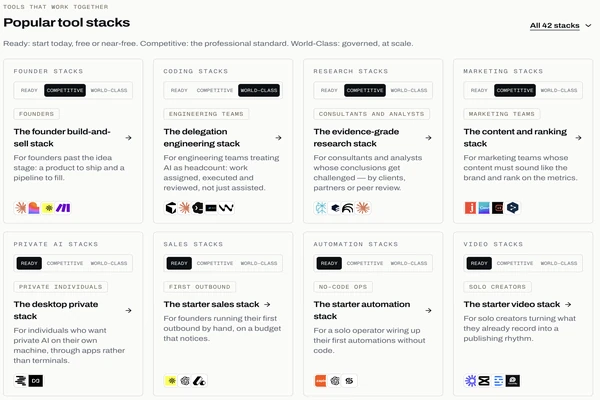
For most businesses, the question is not which single AI tool to adopt but how to build a set of AI capabilities that work together effectively. An operations team might use one tool for meeting transcription and action item extraction, a different tool for document drafting, another for data analysis, and a separate platform for customer communication automation. The challenge is selecting tools that complement rather than overlap with each other and that can share data and outputs across workflows.
This stack-building perspective changes the evaluation criteria. Individual tool capability still matters, but compatibility – whether tools can pass outputs to each other, whether they share a consistent data model, whether a single vendor relationship covers multiple use cases – becomes increasingly important as the number of tools in use grows. Evaluating AI tools in isolation from the rest of the stack that will surround them produces selections that look good individually but create integration problems at scale.
Pricing Structures and Total Cost of Ownership
AI tool pricing structures have become increasingly complex, and the headline price is rarely the whole story. Per-seat licensing, usage-based pricing, API call charges, storage costs, and premium feature tier gates all contribute to a total cost of ownership that can diverge substantially from initial expectations. A tool that appears affordable at low usage volumes can become expensive at scale, and a tool that seems premium-priced may offer better total cost when usage-based charges are factored in.
Before committing to any AI platform, it is worth modelling the expected cost at three different usage levels – current anticipated use, moderate growth, and high adoption – to understand the cost trajectory and identify any inflection points where pricing structures create significant jumps in cost.
Making a Confident Final Decision
The goal of a good AI tool selection process is to arrive at a decision you can be confident in – not certainty that you have found the perfect option, which rarely exists, but confidence that you have evaluated the relevant alternatives systematically, understood the trade-offs involved, and selected the best available option for your specific situation.
For businesses working through this process, structured compare AI tools resources that allow side-by-side evaluation across consistent criteria significantly reduce the research burden and improve the quality of the final decision. The AI landscape will continue to evolve rapidly, but a selection process grounded in clear use cases, honest comparison, and realistic assessment of integration requirements will consistently produce better outcomes than decisions driven by marketing exposure or peer recommendation alone.
The investment in getting this right is worth making. AI tools that genuinely fit your workflow compound in value over time as teams develop fluency and identify additional use cases. Tools that are a poor fit generate ongoing frustration, underutilisation, and eventually the cost of replacement. Taking the selection process seriously from the outset is the most reliable path to the former outcome rather than the latter.
Link 1: ‘Agentarius’ → agentarius.ai | Link 2: ‘Agentarius AI Guide’ → /ai-guide | Link 3: ‘compare AI tools’ → /ai-guide/compare | 1,100+ words
