

In a world where agility, talent scarcity and digital disruption are the new normal, IT outstaffing and outsourcing have transcended “just cost-cutting” to become strategic levers for growth, innovation and resilience.
Executive Summary
The global market for IT services, outstaffing and outsourcing is burgeoning—estimates for 2024 place it at between USD 600 billion and USD 745 billion, and projections through 2030 point to growth to over USD 1.2 trillion.
This expansion is being driven by multiple forces: (1) the infiltration of AI, automation, cloud and platform-driven models into IT delivery; (2) a tightening talent market and the pressure to source specialised skills globally; (3) shifting geography of service delivery, with nearshore and multi-site models gaining prominence; and (4) contracting and governance models evolving from simple FTE/hourly to outcome-based, value-sharing and extended-workforce ecosystems.
For enterprise buyers, this means that outsourcing/outstaffing is no longer an afterthought but integral to digital strategy—it demands rigorous sourcing, governance, talent strategy and vendor/partner alignment. For service providers, differentiation now lies less in cost arbitrage and more in building vertical expertise, platform-enabled offerings and flexible talent models.
Definitions & Taxonomy
To clarify:
- IT Outsourcing means contracting out IT functions (such as application development, infrastructure management, support, or cloud services) to an external provider. The provider manages the service delivery, usually under a contract.
- IT Outstaffing (also called staff-augmentation or dedicated team model) means that a provider supplies resources (engineers/developers/testers) who are technically managed by the client (or jointly), but the legal employment and administrative burden lies with the provider.
- Adjacent models include: managed services (outsourcer takes end-to-end responsibility for a function, often with outcome pricing); nearshore/offshore (geographic sourcing models); captive/GIC (Global In-house Centre) where the client sets up its own delivery centre in another location.
Why it matters: Terminology influences risk allocation, contract type, vendor selection, pricing, intellectual property (IP) ownership and exit planning. A “dedicated team” often carries risks of knowledge transfer, loyalty/turnover and overlapping with internal teams; a “managed outcome” model brings different pricing and governance dynamics.
Market Size & Growth
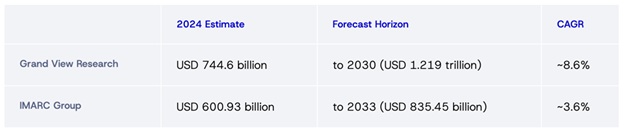
Estimates for the global IT services outsourcing market illustrate both its scale and the variance in measurement.
- According to Grand View Research, the global IT services outsourcing market size was estimated at USD 744.6 billion in 2024, and projected to reach USD 1.219 trillion by 2030, representing a 8.6% CAGR for 2025–2030.
- In contrast, IMARC Group estimates the 2024 market at USD 600.93 billion, with growth at a more modest CAGR of 3.64% through 2033.
- A further variant from Mordor Intelligence lists the IT outsourcing market at USD 618.13 billion in 2025 and forecasts USD 732.38 billion by 2030 (3.45% CAGR).
These differences stem largely from what is included (pure IT services vs broader outsourcing, inclusion of cloud, BPO, staff augmentation), geographic scope, and service models. For readers: treat the market size as a range rather than point-estimate.
Regionally, Grand View identifies North America as dominating (32%+ share in 2024) and the Asia-Pacific as the fastest-growing (11% CAGR projected).
From a service perspective, sectors such as Banking, Financial Services & Insurance (BFSI) remain large consumers of outsourcing.Table (excerpt):
Drivers of Change
AI & Automation
The advent of generative AI, automation (RPA, chatbots) and intelligent service-delivery is shifting what companies expect from an outsourcing partner. For example, automation is already replacing routine service-desk and back-office roles in some hubs.
This pushes service providers to re-sketch operating models: fewer people doing repetitive work, more specialists, higher value services.
Cloud & Platformisation
Rather than outsourcing discrete tasks, enterprises are increasingly outsourcing the running of cloud environments, platform operations, DevOps teams and SRE (site reliability engineering) models. The shift from “we need a vendor to manage infrastructure” to “we need a vendor to run our platform as code” alters contract terms, skill sets and risk profiles. (See commentary on cloud-based outsourcing trends.)
Talent Shortage & Skills Shift
Across the globe, organisations are finding it hard to hire and retain specialists in AI/ML, cloud, cyber-security, data engineering. As highlighted by the 2024 Deloitte Global Outsourcing Survey (500+ executives), “multidimensional sourcing” is becoming core: retained organisation + outsourcing ecosystem + global in-house centre + digital workforce.
This means outstaffing models (dedicated teams) are less about simply cheaper labour and more about accessing scarce specialist skills globally.
Geopolitics & Risk
Data-residency requirements, rising scrutiny of offshore delivery countries, supply-chain disruptions and nearshoring preferences are all shaping where and how firms outsource/outstaff. The war for talent is geographically distributed; companies are rebalancing between offshore (cost) and nearshore/on-shore (risk, collaboration, timezone).
Sustainability & Supplier Consolidation
Buyers are increasingly expecting environmental, social, governance (ESG) compliance from their partners, expanding the criteria beyond cost and delivery. Meanwhile, we’re seeing fewer, larger strategic providers absorbing smaller niche ones—driving consolidation in the market and shifting the dynamics of partner ecosystems.
Delivery Models & Contracting Trends
The traditional model — hourly billing, FTE (full-time equivalent) headcount, offshoring cost arbitrage — is increasingly being challenged. Key evolutions:
- Movement toward outcome-based contracts: providers are rewarded on business outcomes, KPIs, speed to market, quality & innovation rather than simply hours delivered.
- Blended teams: internal teams + outstaffed (or outsourced) external teams + vendor-managed modules — requiring orchestration.
- Pricing innovation: Transitioning to subscription, managed-service pricing, “as-a-service” models, gain-share.
- Flexible talent models: On-demand talent pools, fractional assignments, even “talent as a service” (TaaS).
- Vendors are packaging more value-added services (analytics, insight, innovation labs) rather than purely execution.
These shifts demand different governance frameworks: shared risk, joint governance, knowledge transfer clauses, faster ramp-up/exit, closer alignment to business stakeholders.
Regional Landscapes
South Asia (India, Philippines)
India remains a heavyweight in the outsourcing world: massive talent pool, mature vendor ecosystem, strong cost arbitrage. But pressures are mounting: AI and automation are replacing routine roles, prompting a pivot toward higher-value work.
The Philippines remains key for voice/back-office, English-proficiency and customer-service outsourcing.
Eastern Europe (Ukraine, Poland, Romania, etc.)
Nearshoring to Eastern Europe is increasingly popular among Western European firms due to timezone/cultural alignment, engineering capabilities, and EU regulatory alignment. Ukraine (pre-war aside) and Romania continue to be strong engineering talent sources.
Advantages: higher engineering skill vs cost, proximity. Risks: geopolitical, currency, talent competition.
Latin America (Mexico, Argentina, Brazil)
For U.S. buyers, Latin America offers nearshore benefits: similar timezone, cultural affinity, rising developer quality. The pandemic accelerated remote-work acceptance and buoyed this region’s appeal.
For each region: growth drivers include talent supply, cost arbitrage, time-zone/cultural fit; key risks include political/regulatory instability, currency fluctuations, talent war, rising wages.
Technology & Service Trends
Generative AI & Agentic AI
Outsourcing providers are integrating gen-AI into development/testing (e.g., code generation, automated testing, AI-driven operations), and into service delivery (chatbots, virtual agents). Firms must evaluate the hype vs reality—governance around AI, quality/accuracy, data privacy and vendor risk are essential.
Observability, DevOps, FinOps & AIOps
With increasing cloud adoption and hybrid-multi-cloud complexity, vendors are extending services into observability, performance management, FinOps (cloud cost management) and AIOps (AI-driven operations). These high-value services are increasingly part of outsourcing scopes.
Security & Privacy
As outsourcing ventures touch more critical systems and data, security, compliance and supply-chain risk become front-and-centre. Outsourcing partnerships must embed cyber protections, data-residency/legal compliance, vendor-risk management and audit capabilities.
Cloud-Native Transformation & Platform Teams
Instead of traditional lift-and-shift, many enterprises partner with vendors for cloud-native architecture, microservices, platforms, SRE-led operations, site reliability engineering. This expands the scope of outstaffing/outsourcing into architects, product engineers, DevOps specialists.
Risks, Governance & Compliance
Outsourcing/outstaffing is not without risk:
- Data privacy & cross-border transfers: Terrains such as GDPR, localisation laws, IP ownership need tight governance.
- Vendor lock-in & contract complexity: Outcome-based models may create less transparency and harder exit paths if not well structured.
- Talent turnover & knowledge loss: Especially in outstaffing models where external staff may migrate, the risk of knowledge drain is real.
- Service-delivery quality vs cost: With greater focus on automation, providers may under-deliver on bespoke/custom needs.
- Governance: Modern outsourcing requires joint governance frameworks, dynamic KPI tracking, risk-sharing mechanisms, clear roles. The 2024 Deloitte Survey emphasised the importance of “orchestrating the extended workforce ecosystem”.
Buyers should embed robust exit strategies, knowledge-transfer plans, audit rights, periodic vendor health-checks and collaborative governance with vendor providers.
Talent & Workforce Strategy
Given global talent shortages, outstaffing and outsourcing become strategic tools for sourcing capabilities. Critical elements:
- Skill access: Using outstaffed/outsourced talent to fill hard-to-source skill pools (AI/ML, cloud engineers, SRE).
- Balance of internal vs external: Internal teams should focus on core IP, innovation, architecture; external teams focus on execution, scale, commodity higher-volume work.
- Reskilling/upskilling: With automation displacing some roles, investment in training for higher-value roles is vital.
- Global In-house Centres (GICs): As the Deloitte survey notes, GICs are resurging as strategic hubs within broader sourcing ecosystems.
- Supplier-ecosystem talent: Providers need to offer talent flexibility, fractional specialists, and access to specialised pools rather than purely body-count models.
Case Studies / Short Examples
Case Study 1: Financial-Services Bank & Nearshore Partner
A large European bank outsourced its mobile/app-development function via a nearshore partner in Eastern Europe under an outcome-based contract (time-to-market, customer-satisfaction KPIs). Result: 30% faster releases, 25% cost savings, but required rigorous governance and a joint product-team model rather than traditional FTE outsourcing.
Case Study 2: SaaS Vendor + Eastern Europe Outstaffed Team
A mid-sized SaaS firm retained product-management and architecture in-house (US), while spinning up a dedicated outstaffed engineering team in Poland (20 engineers). The model allowed scaling while keeping control of product roadmap and UX. Risk: turnover in local team led to knowledge fade; mitigated by structured hand-over, buddy-system, alignment rituals.
Case Study 3: Contact-Centre Automation in India
In India, generative-AI chatbots and voice-bots are replacing high-volume routine customer-service and back-office functions. One study shows up to 70-80% of routine jobs may be automated in coming 5 years. The shift means the outsourcing vendor must evolve from labour arbitrage to AI-enabled service modelling.
Future Outlook & Scenarios
Scenario A – Consolidation & Platformisation
Where buying organisations demand fewer vendors, deeper capabilities, and more platform-enabled delivery. Large providers absorb smaller ones; boutique specialists provide niche services.
Scenario B – Automation-First Delivery
Outsourcing/outstaffing models increasingly leverage automation: fewer people doing more via AI/automation, talent specialised in high-value tasks such as oversight, design, outcomes. Standard tasks automated.
Scenario C – Distributed Talent & Near-shoring Hybrid
Rather than purely offshore cost models, hybrid delivery combining on-shore/nearshore/offshore becomes normative. Geography becomes less about cost and more about talent, risk and collaboration. Near-shore (Latin America, Eastern Europe) and remote micro-locations gain traction.
Timeline & Implications
- Short-term (1–2 yrs): more pilot AI outsourcing, renegotiation of rates, growth in near-shore.
- Medium-term (3–5 yrs): outcome-based contracts become commonplace; staffing models shift; knowledge-transfer and governance frameworks become more sophisticated; supplier ecosystem engineering matters.
Practical Recommendations (Checklist)
For Buyers:
- Define clear outcomes and KPIs – not just FTE or hours.
- Start with pilot engagements (especially for AI/automation) before scale.
- Insist on knowledge transfer, exit strategy, intellectual-property clarity and ramp-down planning.
- Choose vendors who offer flexible talent models, specialised skills, platform-capabilities (not just body-count).
- Build a governance model for the extended workforce (internal + vendor + outstaffed), with clear roles, joint steering, measurable outcomes.
For Vendors / Providers:
- Move beyond cost arbitrage: invest in vertical expertise, automation, platform-services and outcome-pricing.
- Build talent supply chains and reskilling programmes for new skills (AI, DevOps, SRE).
- Offer flexible engagement models (dedicated teams, fractional specialists, on-demand pools) instead of rigid FTE models.
- Develop strong governance/licensing frameworks, data security, and global delivery capabilities (near-shore, off-shore hybrid).
Demonstrate value beyond execution: insight, innovation, speed to market, analytics.
