
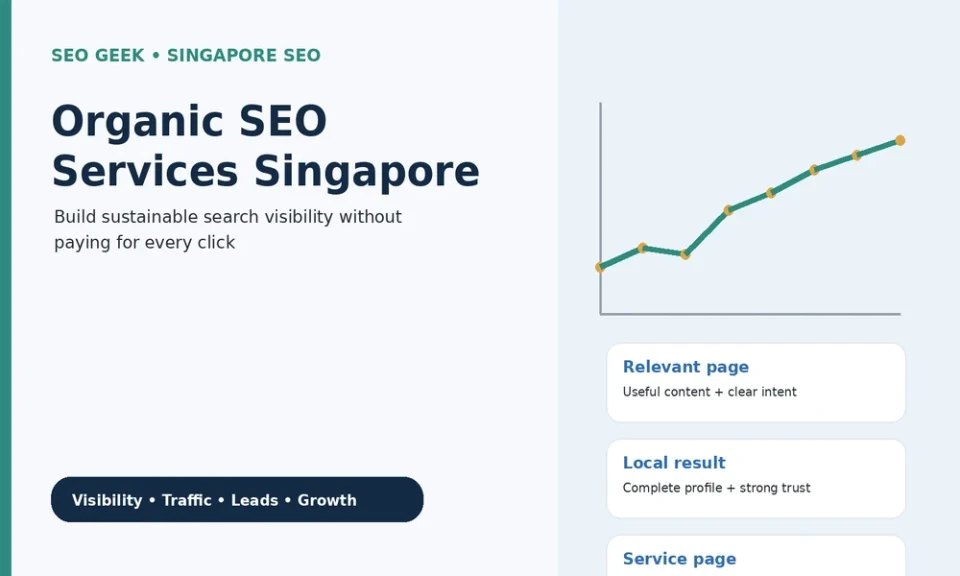
Paid advertising can put a business in front of potential customers quickly, but visibility usually falls when the campaign stops spending. Organic search works differently. With a well-planned SEO strategy, useful pages can continue appearing in unpaid search results and attract people who are actively researching products and services. For companies looking for Organic SEO Services Singapore, the goal should be sustainable search growth built on strong website foundations rather than temporary ranking tricks.
SEO Geek provides Singapore SEO services covering audits, keyword research, on-site SEO, technical SEO, content strategy, backlinking and performance reporting. These areas form the core of organic SEO because they improve both how search engines interpret a website and how effectively the website answers real customer needs.
IMAGE 1: 02_organic_seo_services_singapore_banner_1.png

What Is Organic SEO?
Organic SEO is the process of improving a website’s unpaid visibility in search engines. The objective is to earn relevant search traffic by making pages easier to crawl, understand and trust while also providing useful information and a strong experience for visitors.
Google’s SEO Starter Guide explains that SEO is about helping search engines understand content and helping users find a site through search. That definition is useful because it moves the discussion away from shortcuts and toward the work that actually makes a website more discoverable and useful.
Organic SEO normally combines four major areas:
- Technical SEO so search engines can crawl and index important pages.
- On-page SEO so each page clearly communicates its topic and purpose.
- Content that answers the user’s search intent and builds topical depth.
- Authority development through relevant links, mentions and reputation signals.
Why Organic SEO Is Attractive to Singapore Businesses
Singapore is digitally competitive. Consumers and B2B buyers frequently research providers online before making contact, which means search visibility can influence who gets included in a customer’s shortlist. Organic SEO is especially attractive when a company wants to build a traffic source that does not require paying for every individual visit.
That does not mean organic traffic is “free.” Businesses invest in audits, content, development, strategy and ongoing optimisation. The difference is that the asset being built – the website and its search visibility – can continue generating exposure after individual pieces of work are completed.
Organic SEO Begins With a Website Audit
Before creating new pages, it is sensible to understand what already exists. An SEO audit identifies issues that may be limiting search performance and helps the team prioritise the highest-impact work.
A practical audit can examine:
- Which pages are indexed.
- Whether important pages are blocked or difficult to crawl.
- Broken links and redirect chains.
- Duplicate or overlapping pages.
- Site architecture and internal linking.
- Mobile usability.
- Page performance.
- Title tags, headings and page structure.
- Thin or outdated content.
- Keyword-to-page alignment.
- Backlink quality and authority gaps.
SEO Geek lists SEO audits as part of its organic SEO service offering. The strongest audits do not simply generate a list of errors. They turn findings into a prioritised roadmap based on effort, risk and commercial value.
Keyword Research Should Reflect Real Buyer Intent
A local Singapore business may discover hundreds or thousands of keywords relevant to its industry. Trying to target all of them at once is usually inefficient. The better approach is to group keywords by intent and map them to suitable pages.
Commercial-intent keywords often belong on service or product pages. Informational queries may be better answered with guides or FAQs. Comparison searches can support decision-stage content, while location-modified terms may require a local SEO approach when the business genuinely serves those areas.
Keyword research should also consider difficulty, current rankings, conversion value and how well the business can satisfy the query. A lower-volume keyword that closely matches a profitable service can be far more valuable than a broad high-volume phrase that attracts poorly qualified traffic.
Content Quality Matters More Than Content Volume
Publishing frequently can help only when the content itself is useful. Google’s people-first content guidance specifically encourages original, substantial and complete content created for an intended audience. It also warns against producing large amounts of content simply because topics appear to attract search traffic.
For organic SEO, content should have a clear reason to exist. A strong article may answer a common customer question in depth. A service page may explain scope, process, pricing factors, FAQs and next steps. A case study may demonstrate how a problem was solved. The best content reduces the need for the reader to return to Google and continue searching for basic answers.
On-Page SEO Turns Good Content Into Clear Search Signals
Even useful content needs structure. On-page SEO helps search engines and readers understand the subject quickly.
Important elements include:
- A descriptive title that reflects the page topic.
- A clear H1 heading.
- Logical subheadings.
- Natural use of relevant terms and entities.
- Internal links to supporting pages.
- Descriptive image alt text.
- Readable paragraphs and lists.
- A clear call to action when the page has commercial intent.
SEO Geek’s SME SEO offering includes keyword research, on-page optimisation and content strategy, which are most effective when they are planned together. Keyword research identifies the demand, content addresses the need, and on-page optimisation makes the purpose easy to understand.
IMAGE 2: 02_organic_seo_services_singapore_banner_2.png

Technical SEO Protects Organic Growth
A site can have excellent writing and still underperform if technical issues prevent pages from being crawled or create a poor user experience. Technical SEO ensures that the site provides a reliable foundation for the content strategy.
Businesses should pay attention to crawlability, indexation, URL structure, redirects, internal linking, mobile usability, site speed and duplicate-page management. Technical priorities vary by website. A small local service site may need relatively straightforward fixes, while a large ecommerce platform can have complex faceted navigation, product duplication and crawl-management issues.
SEO Geek includes technical SEO within its Singapore SME SEO services, alongside continuous support and reporting. That ongoing element matters because websites change: developers launch new templates, products are added, old pages are removed and content teams publish new material. Technical SEO is therefore not always a one-time exercise.
Backlinks Should Support Authority, Not Just Metrics
Relevant external links and mentions can help build a website’s authority and discoverability. Google’s link documentation explains that links are used to find new pages and as signals for understanding relevancy. However, businesses should avoid treating backlink counts as the only objective.
A smaller number of relevant editorial references can be more meaningful than a large number of unrelated, low-quality placements. Organic off-site SEO can involve industry publications, associations, business partners, supplier pages, legitimate directories, PR coverage and genuinely useful contributed content.
Ask an SEO provider where links will come from and why those sources make sense for the business. Transparency is more important than a promise to deliver a fixed number of links every month regardless of relevance.
Organic SEO and Local SEO Can Work Together
For Singapore businesses that serve customers at a physical location or within a service area, local search visibility can complement normal organic rankings. Google Business Profile, local landing pages, reviews, business information and relevant local authority signals can influence how easily nearby customers find the company.
Google states that local results are mainly based on relevance, distance and prominence. Its local ranking guidance recommends complete and accurate profile information, appropriate categories, reviews and photos. Organic website SEO can reinforce that local presence by giving the business strong service pages and location-relevant content.
How Long-Term Organic SEO Compounds
The phrase “SEO compounds” should not be interpreted as guaranteed growth. Search rankings can move up or down, competitors improve their sites and Google changes how results are presented. However, a well-maintained site can accumulate useful assets over time: stronger pages, more internal links, better topical depth, relevant external references and improved brand recognition.
An article published today may attract links later. A service page improved after keyword research may begin ranking for several related terms. A technical fix may improve the discoverability of an entire section of the site. These effects can build on one another, which is why organic SEO is usually evaluated over months rather than days.
How to Measure Organic SEO Performance
A useful reporting framework should look beyond a single ranking snapshot. Consider:
- Organic sessions and engaged users.
- Visibility across groups of priority keywords.
- Non-branded organic traffic.
- Leads and conversions generated from organic landing pages.
- Growth of pages receiving search traffic.
- Search impressions and clicks.
- Technical health and indexation.
- Backlink quality and relevant referring domains.
- Local profile interactions where applicable.
The most important metric depends on the business model. An ecommerce store may focus on organic revenue, while a professional-services company may care more about qualified enquiries and consultation requests.
When Organic SEO Is a Good Fit
Organic SEO is particularly suitable when:
- Customers actively search for the service or product.
- The business plans to operate for the long term.
- The website can be improved technically and editorially.
- The company can support consistent content and implementation.
- There is a clear commercial value to qualified search traffic.
Businesses needing immediate leads may combine SEO with paid advertising rather than expecting organic results immediately.
Choosing an Organic SEO Provider in Singapore
Look for a provider that can explain the strategy in practical terms. Avoid agencies that promise guaranteed first positions, refuse to explain where links come from or focus only on keyword density. A responsible provider should discuss the site’s current condition, competitors, priorities, expected timeline and measurement plan.
SEO Geek states that it uses ethical, white-hat techniques and does not guarantee first-page rankings. It also offers SEO consultancy in Singapore for businesses with internal teams that need expert review and strategic direction.
Final Thoughts
Organic SEO services Singapore businesses can rely on should build durable search assets rather than chase temporary ranking movements. The work combines technical quality, content usefulness, search intent, internal structure, authority development and continuous measurement.
SEO Geek offers these core disciplines through its Singapore SEO services for SMEs and other businesses. Companies considering an organic search programme can begin with an audit and keyword strategy, prioritise the pages most likely to generate business value, and expand once the site has a stronger foundation.
