
Relationship-tech products can get creepy very quickly when they start implying they can reveal hidden messages or private behavior.
There is a less invasive-and frankly more useful-way to do it.
Use public information. Organize it well. Be very clear about what the data can and cannot tell you.
That is the approach behind SocialSleuth.xyz.
1. Public activity can show behavior, not private intent
There is a big difference between seeing what happened and knowing why it happened.
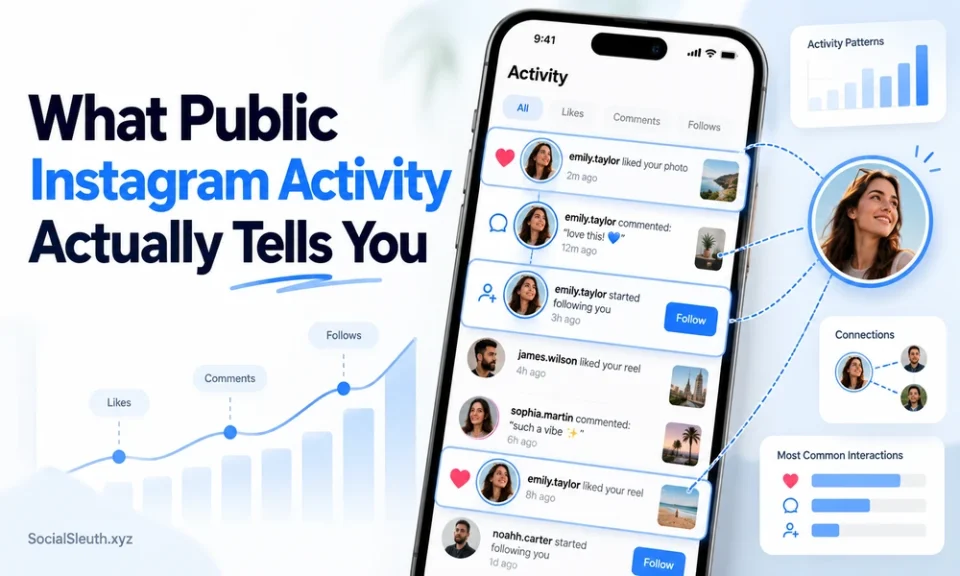
Public Instagram activity can show which accounts keep appearing in likes, who comments most often, whether a new person enters the visible engagement circle, whether the same emoji keeps repeating, or whether interaction suddenly shifts late at night.
Those are all things you can actually observe.
What public activity cannot tell you is why someone followed another person, what happened in a private conversation, or what a relationship means offline.
A report might show that one person appeared in eight recent interactions.
That is useful.
Saying why Account A appeared eight times would be a guess.
That line matters.
2. You need a picture of what is normal first
One of the easiest ways to overread social activity is to notice something without knowing whether it is new.
Three comments might be a lot on one account and completely ordinary on another.
SocialSleuth.xyz starts with an initial activity snapshot built from public activity. It shows which accounts normally like, who regularly comments, which people already sit in the top-engager group, what interaction timing usually looks like, and which emoji patterns are already common.
Say someone comments three times this week.
If that has been happening every week for months, nothing much changed.
If Account C barely appeared before and suddenly comments three times in two days, that is a different story.
Knowing what “normal” looks like makes the change easier to see.
3. Several public signals are more useful than one
One like is weak information.
So is one follow.
So is one emoji.
But if the same account starts appearing across several different public signals, you get a clearer picture.
SocialSleuth.xyz can connect repeated likes, more personal comments, follow changes, recurring emojis, late-night interaction, and movement into the top-engager group.
A new follow that never appears again is one thing.
A new follow that is quickly followed by repeated likes and more personal comments is another.
Neither proves anything private.
But one pattern gives you more public context than the other.
4. Weekly reporting is a better rhythm than constant checking
There is also a product-design reason not to send an alert for every single interaction.
That kind of experience can make people check more, not less.
SocialSleuth.xyz compares new activity with what is normally seen on the account and summarizes meaningful changes week by week.
That gives users a little distance.
Maybe you feel like one account is suddenly becoming very active, but the weekly view shows it was only a two-day spike.
Or maybe the same account really does stay unusually visible for several weeks.
Both answers are useful.
The privacy boundary
SocialSleuth.xyz does not access private Instagram messages, reveal passwords, bypass private accounts, or expose hidden content.
Its job is much simpler: organize what is already public.
That makes the product both more privacy-friendly and more honest about what it can actually know.
What a responsible tool should do
A responsible relationship-insights tool should help you answer four questions:
What is publicly visible?
What is normal for this account?
Are several public signals pointing to the same person?
What actually changed over time?
Those questions can give you useful context without pretending that public Instagram activity can reveal someone’s private intentions.
.
