
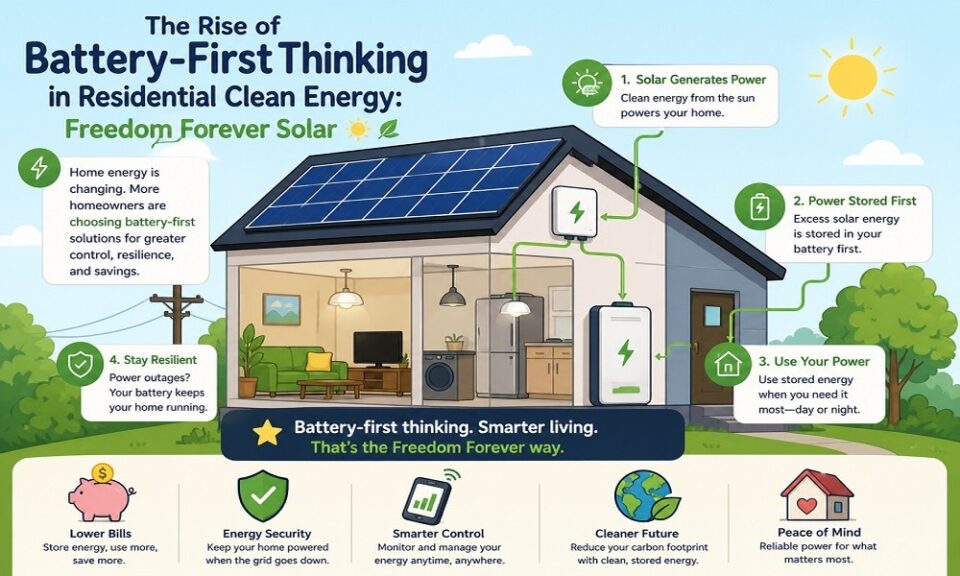
Residential clean energy planning has evolved as homeowners take a broader view of how power supports daily life. Solar panels once sat at the center of these conversations, largely framed around generation and long-term value. Today, energy storage plays a more prominent role. Freedom Forever Solar, one of the nation’s largest residential solar providers, recognizes this shift, as batteries increasingly shape how households think about stability, flexibility, and long-term energy use.
As residential systems integrate solar generation with battery storage, energy planning extends beyond how much power is produced. Attention moves toward how reliably energy supports everyday routines. Battery-first thinking reflects a more coordinated approach to energy management, where production, storage, and usage are planned together rather than treated as separate elements.
From Add-On to Core Design Element
Early residential solar systems focused primarily on generation. Panels produced electricity during daylight hours, and batteries, when included, were often considered optional enhancements rather than central components.
That perspective has changed. Homeowners now recognize that production alone does not address variability in demand or changing grid conditions. Batteries introduce flexibility by allowing energy to be stored and used when it best supports household needs. Storage capacity now influences how solar systems perform throughout the day, shaping overall system design and long-term value.
Stability Shapes Energy Decisions
Stability has become an important consideration for many households. Shifting utility pricing structures, peak demand periods, and changing usage patterns highlight the benefits of managing energy more deliberately.
Battery storage supports stability by smoothing energy use across the day. Homes can draw from stored energy during higher-demand periods rather than relying solely on external supply. This approach promotes predictable operation while maintaining grid connection. Batteries support balance by offering flexibility without requiring constant attention or manual intervention.
Independence Through Flexible Energy Use
Energy independence often reflects flexibility rather than separation. Batteries support this approach by allowing homes to rely on stored energy during select periods when the external supply is less favorable.
During peak pricing windows or times of increased demand, batteries provide options. Homes continue operating smoothly while choosing when to draw from the grid. This flexibility supports planning and confidence. Independence becomes situational, shaped by informed choices rather than permanent separation.
Solar Strategies Begin with Storage
Planning for battery storage changes how solar systems are designed. Homeowners and installers talk about backup early, before the system is sized. They identify which circuits should stay powered and what “enough power” means for the household, from refrigeration and lighting to internet and basic climate control.
When solar and storage are planned together, the system is built around real household priorities. Solar can support daily use when the sun is strongest, while the battery reserves energy for essential needs when conditions shift or the grid goes down. Smart controls can prioritize those critical loads automatically, so the home stays functional without constant manual adjustments.
Daily Use Defines Battery Value
Batteries support more than continuity planning. They play an active role in everyday energy management. Stored energy supports evening routines, early morning activity, and periods of lower solar production.
This daily engagement reshapes how households perceive value. Batteries can contribute during normal operation, not only during outages. Stored energy becomes more available when needed, rather than being tied only to daylight production. In that way, storage functions as household infrastructure that supports routine living.
Smart Controls Guide Battery Behavior
Battery performance depends on how charging and discharging are managed. Smart controls handle that timing by tracking solar production, household demand, and the settings homeowners choose.
These controls decide when to store extra solar power and when to use stored energy to support the home. That coordination reduces waste, protects available capacity, and helps the battery serve both daily routines and backup priorities. With automation in place, homeowners do not have to manage battery behavior manually to keep the system working smoothly.
Visibility Supports Confident Use
Clear insight into battery behavior supports engagement and planning. Monitoring tools display charge levels, usage patterns, and performance trends. Homeowners gain visibility into how storage supports daily routines.
Freedom Forever reviews often highlight communication and access to system information, noting the value of understanding how battery storage interacts with solar production and household demand. These observations reflect how transparency supports confidence. Knowing how storage performs under different conditions reinforces comfort with battery-first system designs.
Resilience as a Daily Quality
Battery storage contributes to resilience during a wide range of conditions. Beyond supporting continuity during disruptions, batteries help homes adapt to everyday variability in demand and production. By storing excess energy for later use, batteries help smooth fluctuations that occur throughout the day. This flexibility allows households to rely less on the grid during peak periods, without changing daily routines. Over time, storage supports a more balanced and predictable energy experience, even as usage needs to shift.
Homes with storage manage energy more evenly, avoiding sharp peaks and sudden shifts. This steadiness supports comfort and consistent performance. Resilience becomes part of daily operation rather than a feature reserved for specific situations.
Planning for Change Over Time
Including storage early keeps the system flexible over time. As households add appliances, adjust routines, or adopt new technology, the setup can evolve without needing a major redesign. When solar and storage are planned together from the start, homeowners are in a better position to upgrade later while keeping energy performance steady and reliable.
Storage provides flexibility that supports gradual growth. Homes adapt without requiring immediate changes to generation capacity. This planning approach allows systems to evolve alongside household needs, supporting continuity and scalability over time.
A Shift in Residential Energy Thinking
Battery storage is changing how households approach clean energy. Storage now shapes system design, daily use, and long-term planning. For many homeowners, a battery is no longer a nice extra. It is part of how the whole setup is meant to work.
As residential energy technology evolves, more households want flexibility and clarity in how their power is managed. When solar, storage, and smart controls are planned together, energy becomes easier to monitor, easier to use well, and more reliable when conditions change.
